
Tropical Cyclones and Climate Change
This page summarizes what the two most relevant authorities -- NOAA's Geophysical Fluid Dynamics Laboratory (GFDL) and the IPCC's Sixth Assessment Report (AR6) -- actually say about the connection between tropical cyclones and human-caused climate change, and links to the primary sources rather than asking you to take our word for it. It closes with a bibliography of Ryan Maue's and Roger Pielke Jr.'s own peer-reviewed work in this area.
Key Takeaways
- Physical trends (GFDL & IPCC AR6 consensus): there is no clear long-term increase in the global frequency of tropical cyclones. Some metrics show increases in the proportion of stronger storms, rapid-intensification events, and rainfall rates, but attribution to human-caused climate change is generally assessed at medium confidence or lower. Future projections indicate storms are likely to become more intense with higher rainfall rates, while projections put overall frequency at a similar level or lower.
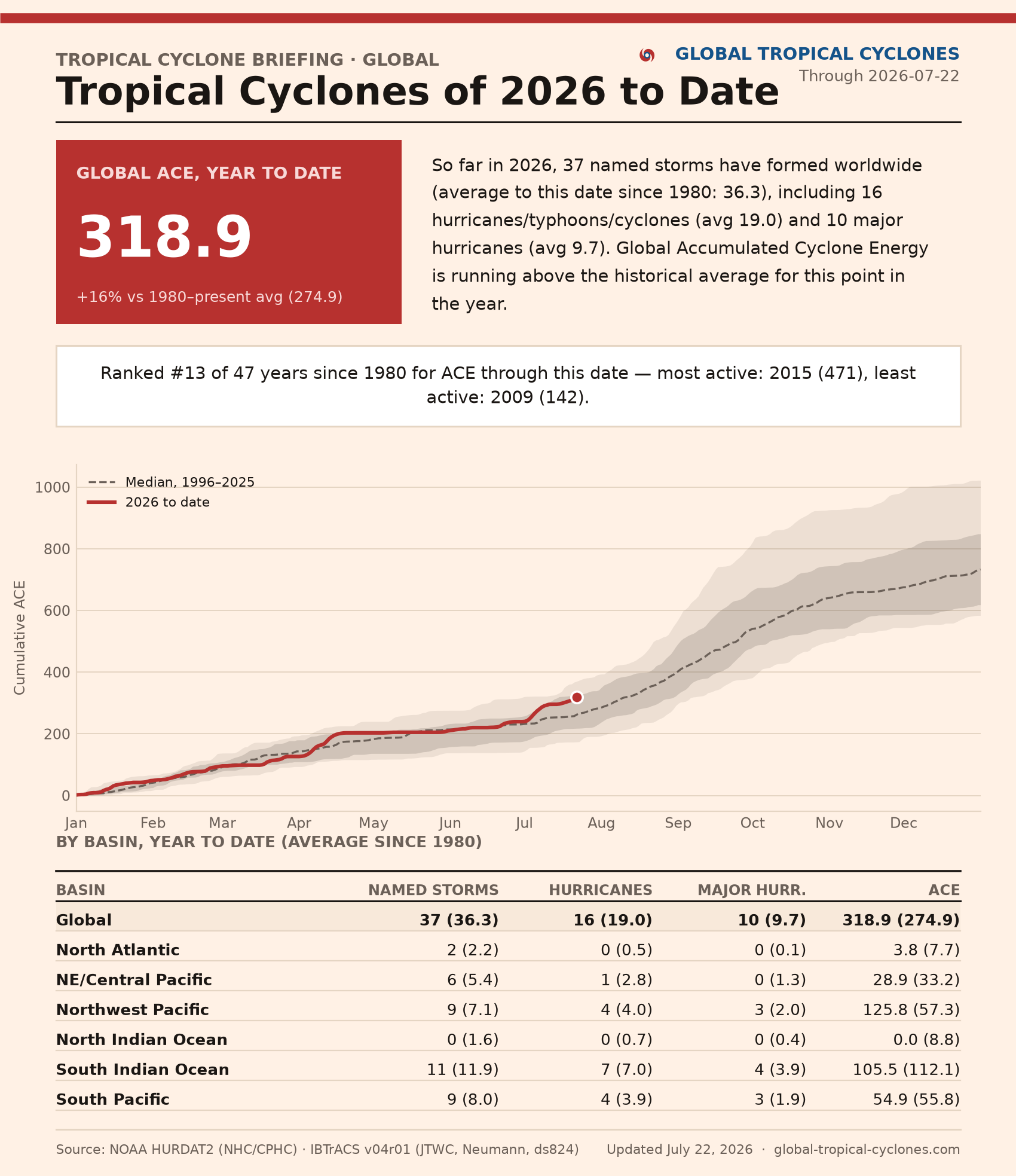
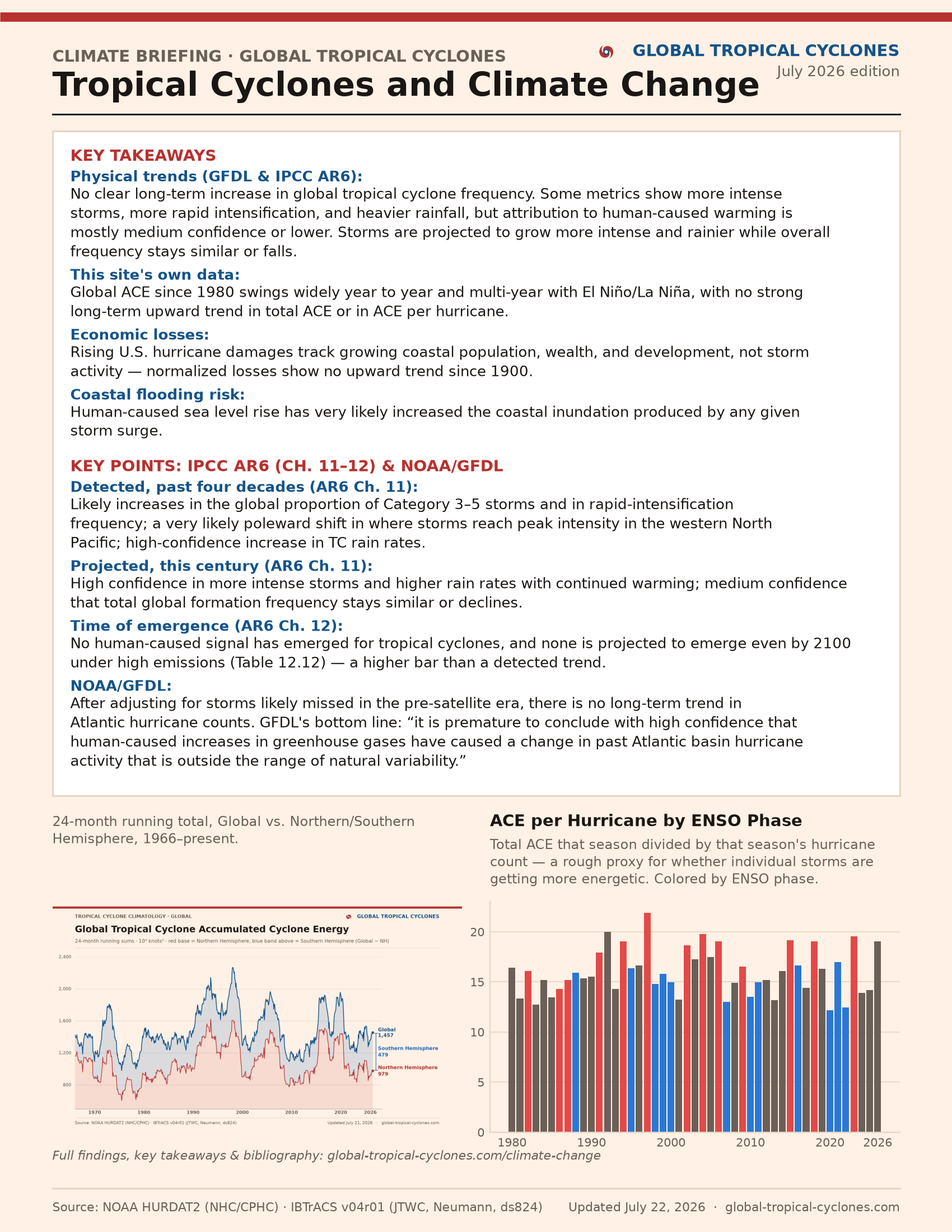
- This site's own data: global Accumulated Cyclone Energy (ACE) since 1980 shows large year-to-year and multi-year variability, strongly influenced by El Niño and La Niña cycles. There is no strong long-term upward trend in total ACE or in ACE per hurricane (a proxy for storm intensity independent of frequency) — see the charts below.
- Economic losses and societal factors: reported hurricane damages have increased over time, but this is driven primarily by growing coastal population, wealth, and infrastructure — not by more frequent or stronger storms. After normalizing historical U.S. damage data to today's societal conditions, studies show no upward trend in losses since 1900 (see Societal Context below).
- Coastal flooding risk: human-caused sea level rise has very likely increased the coastal inundation produced by any given storm surge.
Global ACE, 1980–present
This site's own data, for reference against the literature below: global Accumulated Cyclone Energy by season, and ACE per hurricane by season (total ACE divided by that season's global hurricane count) — a rough proxy for whether individual storms are getting more energetic, independent of how many form in a given year.
ACE by season, 1980–2027
Global, 1980-present · full-history season totals
ACE per hurricane by season, 1980–2027
Global, 1980-present · full-history season totals
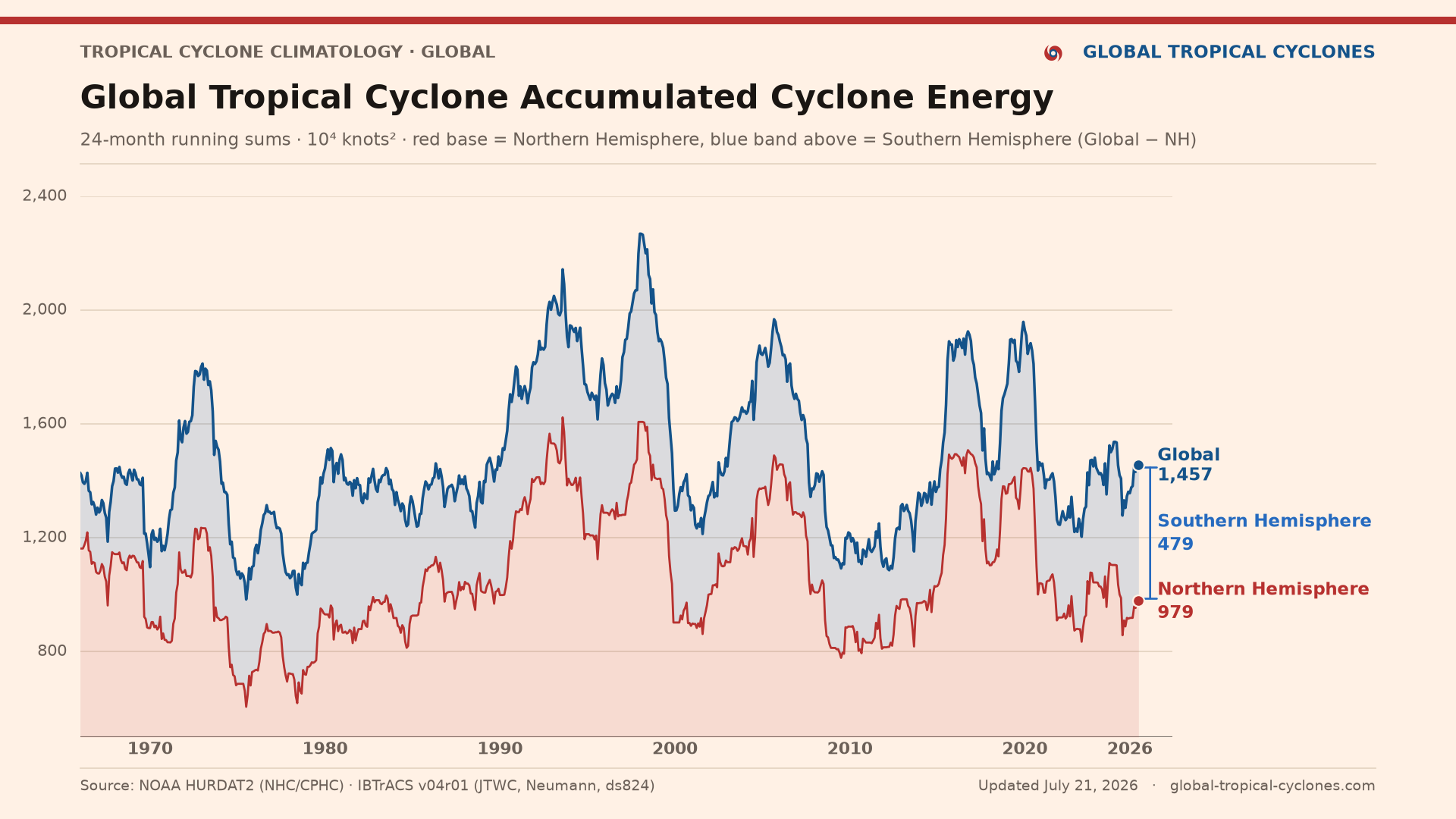
A longer view, back to 1966, smoothed into 24-month running totals rather than discrete seasons — useful for seeing multi-year active/quiet stretches that a single season's bar can obscure:
30-Year ACE Density Climatology
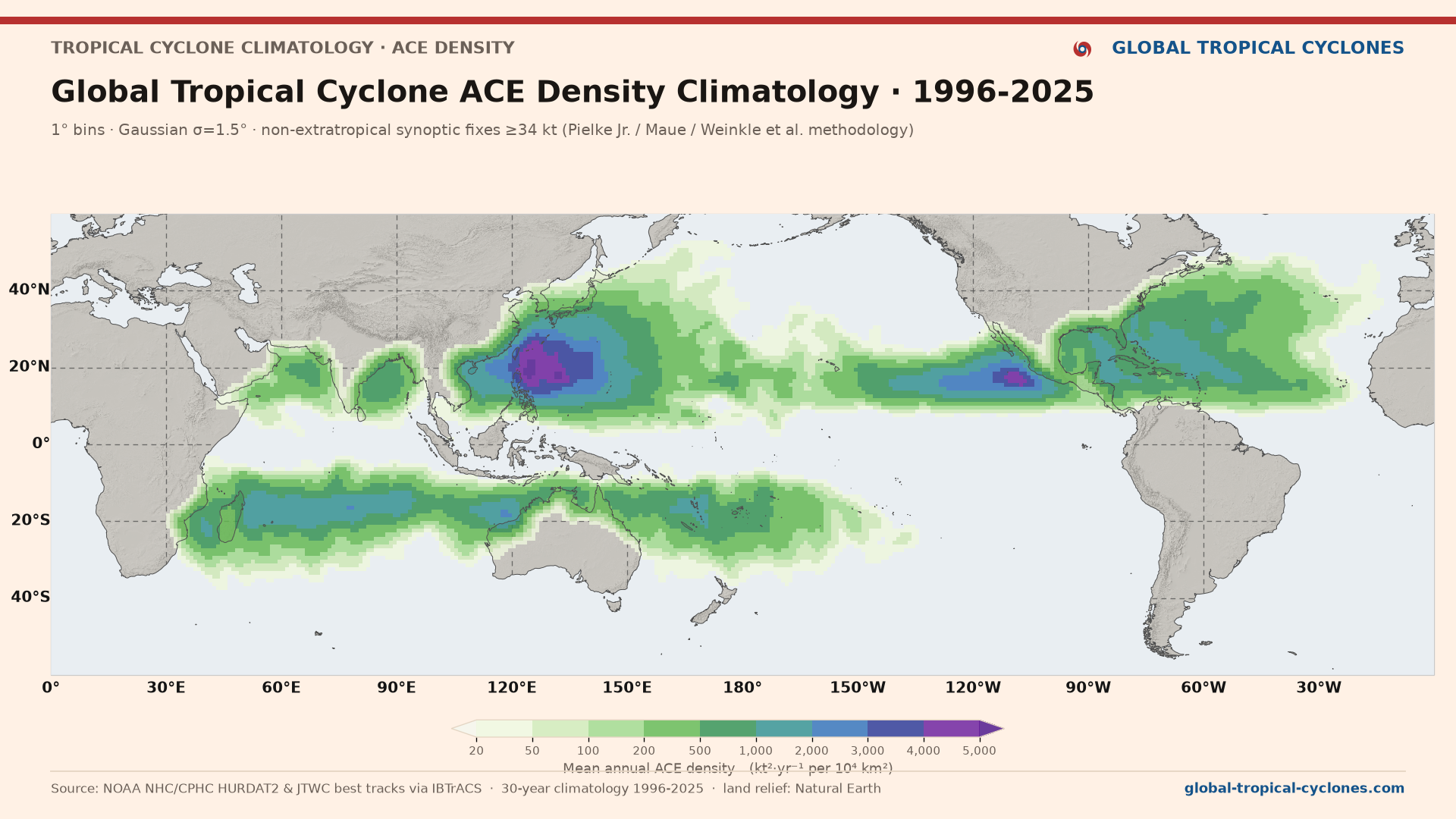
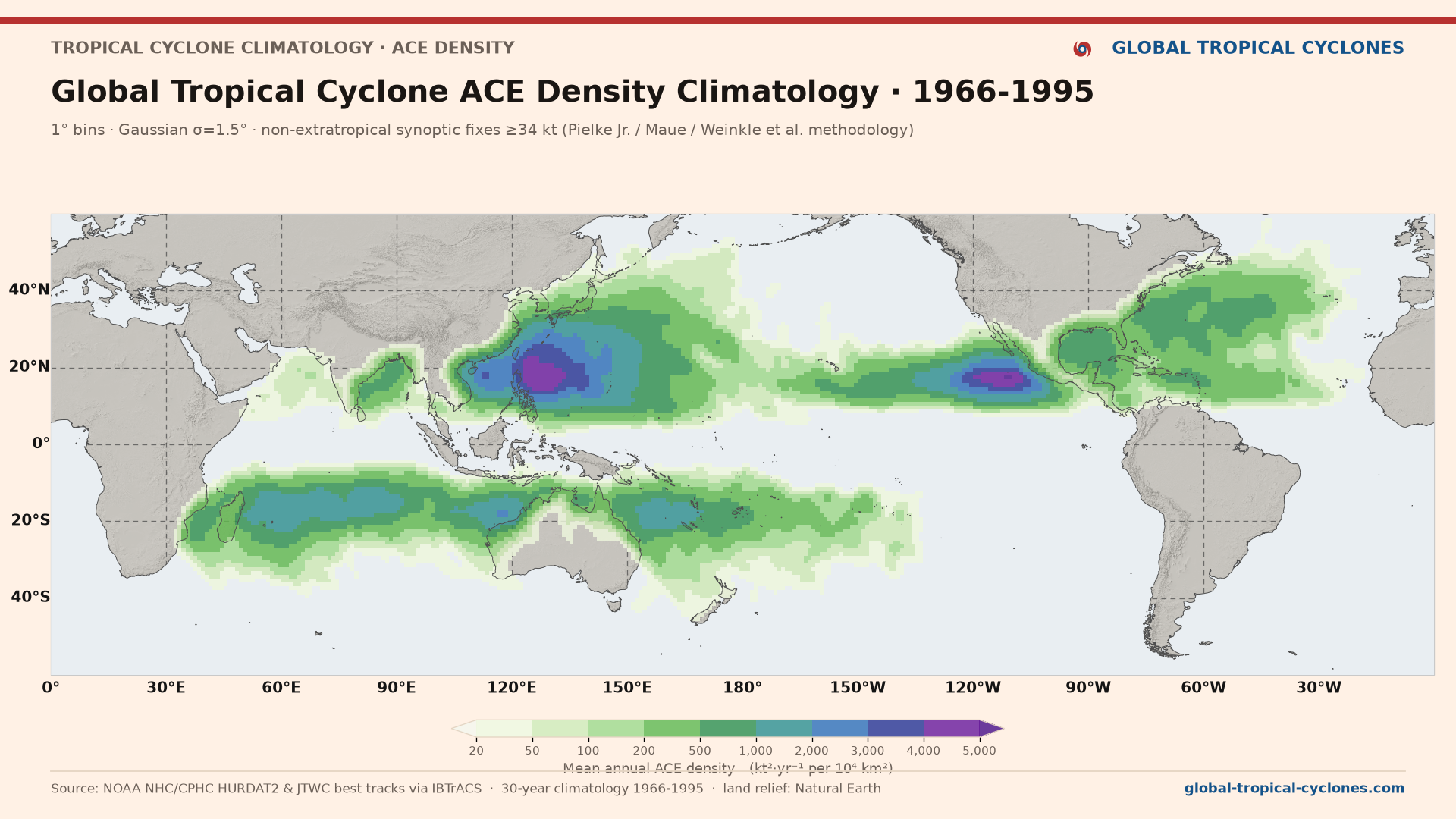
Where, geographically, does that energy actually accumulate? Every eligible best-track fix's ACE is spread along its storm's track, gridded, and averaged over a trailing 30-year window — an areal density (per 104 km2) independent of grid size, so basins with very different areas are directly comparable. The Northwest Pacific and Eastern Pacific (off Mexico) stand out as the two most energetic corridors on Earth in both eras below.
NOAA/GFDL
GFDL's Global Warming and Hurricanes page (last revised November 2024) is the most-cited single summary of the physical-science consensus. Its key points:
- Century-scale frequency: after adjusting for storms likely missed in the pre-satellite record, "there is essentially no long-term trend in [Atlantic] hurricane counts." Measures of Atlantic activity have increased since 1980, but GFDL cautions this recent-decades rise may reflect multidecadal variability rather than a secular trend.
- Intensity (projected): greenhouse warming will likely make hurricanes more intense globally over the coming century, with model projections of roughly 1-10% higher wind speeds and about 14% higher rainfall rates per 2°C of warming.
- Rapid intensification: AR6 assesses the observed increase in rapid-intensification probability since 1982 as detectable with medium confidence, showing a pattern consistent with (but not proof of) anthropogenic forcing.
- Precipitation: high confidence that human-caused climate change has increased extreme tropical cyclone rainfall, though data limitations make global trend detection difficult.
- Sea level / storm surge: human activity has "very likely" been the main driver of sea level rise since 1971, which raises the coastal inundation any given storm surge produces.
- GFDL's own bottom line: "it is premature to conclude with high confidence that human-caused increases in greenhouse gases have caused a change in past Atlantic basin hurricane activity that is outside the range of natural variability."
IPCC AR6 WG1, Chapter 11: detection and attribution
Chapter 11 ("Weather and Climate Extreme Events in a Changing Climate") is the IPCC's primary assessment of observed and attributed trends. Its tropical cyclone section (11.7) assigns a specific confidence level to each claim -- worth reading precisely rather than as a single up-or-down verdict:
- Likely: the global proportion of Category 3-5 tropical cyclones has increased over the past four decades.
- Likely: the global frequency of TC rapid-intensification events has increased over the past four decades.
- Very likely: the average location where TCs reach peak wind intensity has migrated poleward in the western North Pacific since the 1940s.
- Likely: TC translation speed (forward motion) has slowed over the continental United States since 1900.
- High confidence: average and maximum TC rain rates increase in a warming world.
- Medium confidence: none of the above changes can be explained by natural variability alone.
- Medium confidence: event-attribution studies of observed strong TCs support a human contribution specifically to extreme TC rainfall.
The Summary for Policymakers frames the overall detection picture more cautiously than any single bullet above: "event attribution studies and physical understanding indicate that human-induced climate change increases heavy precipitation associated with tropical cyclones (high confidence), but data limitations inhibit clear detection of past trends on the global scale" (SPM, section A.3).
For the 21st century, Chapter 11 projects:
- High confidence: the proportion of intense TCs and their peak wind speeds increase with continued global warming.
- Medium confidence: total global TC formation frequency decreases or stays unchanged with continued global warming.
- High confidence: TC rain rates increase roughly 11% at 1.5°C, 14% at 2°C, and 28% at 4°C of global warming.
IPCC AR6 WG1, Chapter 12: time of emergence
Chapter 12 ("Climate Change Information for Regional Impact and for Risk Assessment") addresses a different question than Chapter 11: not just whether a trend exists, but whether a human-caused signal has emerged -- or is projected to emerge -- from the background of natural year-to-year and decade-to-decade variability. This is the "time of emergence" (ToE) concept, synthesized across dozens of climate impact-drivers in the chapter's Table 12.12, which color-codes each driver by whether a signal has emerged already, is projected to emerge by 2050 or by 2100 under a high-emissions scenario (RCP8.5), or is not expected to emerge in that table's assessment window at all.
Tropical cyclones fall into that last category: no emerged signal to date, and none of the table's projected-emergence categories reached, even out to 2100 under RCP8.5. That is a separate, and more conservative, statement than Chapter 11's trend findings above -- a likely increase in Category 3-5 proportion over four decades (Ch. 11) is a detected trend; it is not the same claim as a signal having emerged from natural variability with enough confidence to be classified in Chapter 12's synthesis. Roger has written a longer, plain-language walkthrough of Table 12.12 and what "emergence" does and doesn't mean: "What the IPCC Actually Says About Extreme Weather."
Chapter 12 adds a forward-looking projection of its own, consistent with Chapter 11's:"Tropical cyclones are expected to increase in intensity despite a decrease in frequency in most tropical regions (medium confidence)" (12.4).
Historical Data Recovery
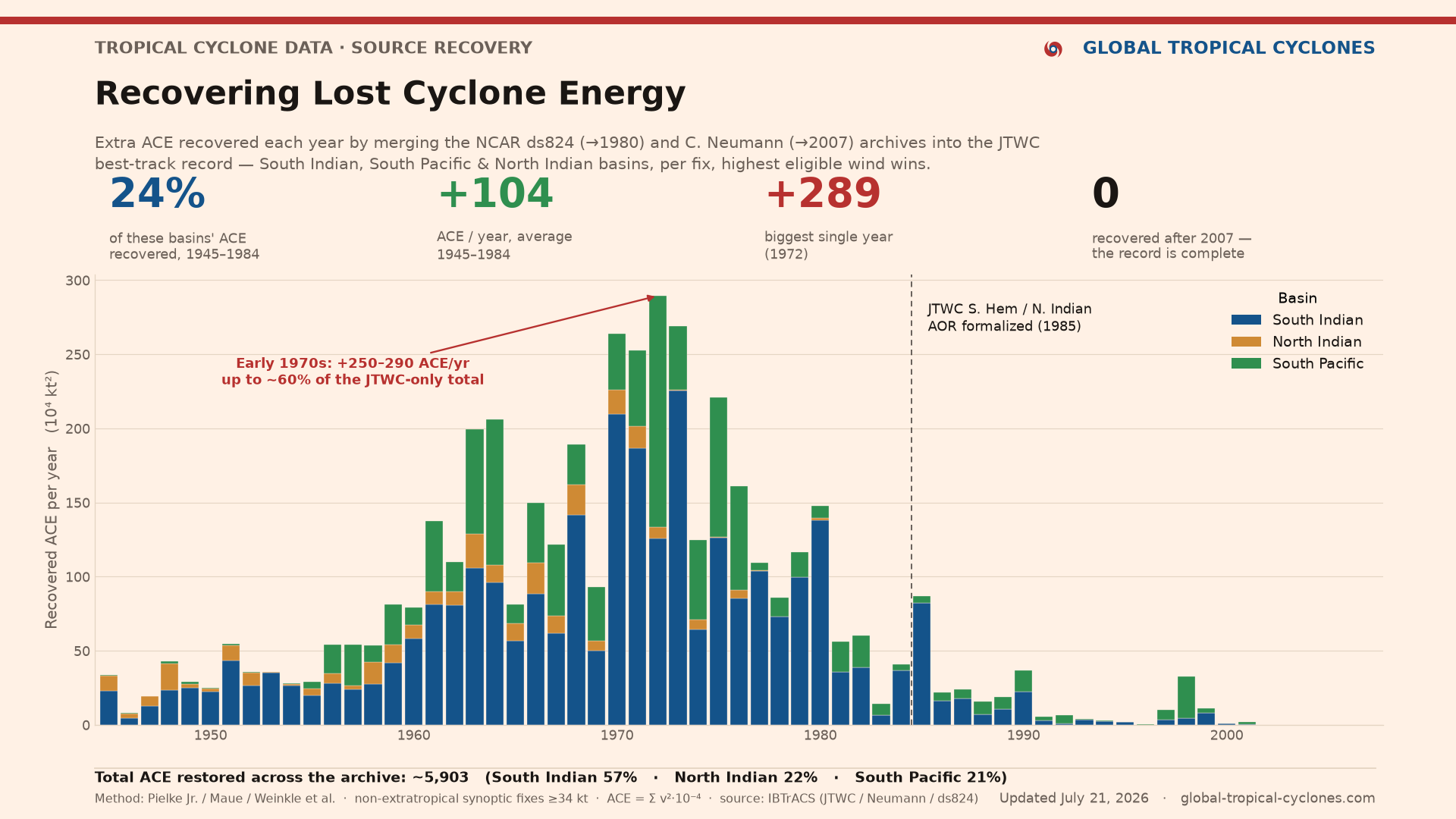
A methodological note relevant to any long-term trend claim above: the South Indian, North Indian, and South Pacific basins weren't formally within JTWC's area of responsibility until 1985, so a JTWC-only record understates pre-1985 activity in exactly those basins. This site recovers that missing energy by merging in the NCAR ds824 (through 1980) and C. Neumann (through 2007) archives storm-by-storm, taking whichever source reports the highest eligible wind at each fix — see Methodology for the full method.
Societal Context: Normalized Hurricane Damages
While trends in the physical characteristics of tropical cyclones are often modest or uncertain, economic losses from hurricanes in the United States have risen sharply in recent decades. Research by Pielke and colleagues demonstrates that these increases are driven overwhelmingly by societal change rather than by any change in storm frequency or intensity.
The update cited above (Weinkle et al. 2018, Nature Sustainability — see Bibliography below) normalized U.S. hurricane damage from 1900–2017 to 2018 societal conditions (accounting for population growth, wealth, and development). Key findings:
- Total normalized losses over the period were approximately US$2 trillion (2018 dollars), or just under US$17 billion per year on average.
- There is no upward trend in normalized losses.
- This result is consistent with the lack of long-term trends in continental U.S. hurricane landfall frequency and intensity.
For context, that same study normalizes the 1926 Great Miami hurricane at roughly $236 billion (2017 dollars) — the single costliest storm in the 1900–2017 record once normalized, ahead of Katrina (2005) or Harvey (2017) at the time of the study.
Related peer-reviewed work in the bibliography below (including Klotzbach et al. 2018 and Weinkle et al. 2012) reaches similar conclusions: rising reported damages reflect increased exposure and wealth along the coast, not a climate-driven increase in storm activity.
Bibliography: Maue & Pielke Jr.
Peer-reviewed work by Ryan Maue and/or Roger Pielke Jr. relevant to tropical cyclones, climate, and economic loss, newest first:
- Weinkle, J., Landsea, C., Collins, D., Musulin, R., Crompton, R. P., Klotzbach, P. J., & Pielke Jr., R., 2018: Normalized hurricane damage in the continental United States 1900–2017. Nature Sustainability, 1, 808–813. doi:10.1038/s41893-018-0165-2
- Klotzbach, P., Bowen, S., Pielke Jr., R., & Bell, M., 2018: Continental United States hurricane landfall frequency and associated damage: observations and future risks.Bulletin of the American Meteorological Society. doi:10.1175/BAMS-D-17-0184.1
- Mohleji, S., & Pielke Jr., R., 2014: Reconciliation of trends in global and regional economic losses from weather events: 1980–2008. Natural Hazards Review, 15, 1–9.
- Weinkle, J., Maue, R., & Pielke Jr., R., 2012: Historical Global Tropical Cyclone Landfalls. Journal of Climate, 25(13), 4729–4735. doi:10.1175/JCLI-D-11-00719.1 -- the methodology this site's own landfall counts follow; see Methodology.
- Crompton, R. P., Pielke Jr., R. A., & McAneney, K. J., 2011: Emergence timescales for detection of anthropogenic climate change in US tropical cyclone loss data.Environmental Research Letters, 6, 014003. doi:10.1088/1748-9326/6/1/014003
- Maue, R. N., 2011: Recent historically low global tropical cyclone activity.Geophysical Research Letters, 38, L14803. doi:10.1029/2011GL047711
- Pielke Jr., R. A., 2009: United States hurricane landfalls and damages: Can one- to five-year predictions beat climatology? Environmental Hazards, 8(3), 187–200.
- Pielke Jr., R. A., Gratz, J., Landsea, C. W., Collins, D., Saunders, M. A., & Musulin, R., 2008: Normalized Hurricane Damage in the United States: 1900–2005.Natural Hazards Review, 9(1), 29–42.
- Pielke Jr., R. A., 2007: Future economic damage from tropical cyclones: sensitivities to societal and climate changes. Philosophical Transactions of the Royal Society A, 365, 2717–2729.
- Pielke Jr., R. A., 2005: Are there trends in hurricane destruction?Nature, 438, E11. doi:10.1038/nature04426
- Pielke Jr., R. A., & Landsea, C. W., 1998: Normalized hurricane damage in the United States: 1925–95. Weather and Forecasting, 13(3), 621–631.
- Pielke Jr., R. A., & Pielke Sr., R. A., 1997: Hurricanes: Their Nature and Impacts on Society. John Wiley & Sons, 279 pp.
See also About for Ryan's and Roger's current writing, and Methodology for how this site builds its data.